The process of challenging the status quo through different lenses of food movements
A guest post by Valentina Bendl
Within a given food system, Food Environments describe the availability, affordability, convenience, and desirability of various foods. By challenging the status quo of the different dimensions of Food Environments, food movements aim to make food systems more sustainable, fair, and democratic.
“The Food regime determines not only what will be produced and where it will go, but also who will profit from agriculture and who will be vulnerable to food crises” (Brinkman et al. 2010)
Friedmann (1993) describes the whole of those cooperations as a “rule-governed structure of production and consumption of food on a world scale“, that has existed since the late 1980s. Subsequently, a growing gap emerged between land and its inhabitants, as well as among nations and their cultural crops, exacerbating the commercialization of both land and labor. Instead of catering to local needs, countries began prioritizing the cultivation of high-yield cash crops for international trade, putting pressure on farmers and agricultural land to generate surplus profits. And indeed, over 50% of the world’s commercial seeds are controlled by three companies: Monsanto-Bayer, Syngenta-ChemChina, and Dupont-Dow. This monopolisation is furthermore facilitated by organizations like the WTO (World Trade Organization), the World Bank, and the IMF (International Monetary Fund). Further, with the progression of urbanization, there was a shift towards purchasing food rather than cultivating it locally. Since then, the countries of the Global North have been persisting in importing various fruits, vegetables, and meat, compelling nations in the Global South to reorganize their agricultural industries to focus on exports: As a result, the various food movements are in essence united by their common counter-hegemonic position on this globally effective corporate food regime. In searching for alternative production models that have great potential to challenge the dominant capitalist commodity, they hold a tremendous amount of energy, creativity, and diversity.
La Via Campesina
Starting with the concept of food sovereignty as one of the more radical ones and which is closely linked to the agrarian citizenship: In turn, agrarian citizenship can be seen as a model of rural action that “protects against both state abuse and market greed” by incorporating the role of civil society and democratic communication, while simultaneously being sensitive to ecological limits. A leading example of this can be found in the global food movement “La Via Campesina” which was founded in the 1990s as rural farmers in the Global South felt the pressures of producing for world agriculture. This region contains 16% of the world’s farmable land, with 33% of the area being suitable but not used for agriculture, 23% of the world’s forests, 50% of the biodiversity, and 31% of the fresh water resources of the planet. Nearly 20% of these lands are guarded by and belong to indigenous peoples. At the same time, structural inequalities are very prevalent, especially concerning rural women, as unpaid family work and informal self-employment affect more than half of them. Building on this foundation, the movement effectively brought attention to the underlying power dynamics within the food system, emphasising issues of control, ownership, and self-determination. La Via Campesina now encompasses approximately 150 local and national organizations across 70 countries spanning Africa, Asia, Europe, and the Americas. Collectively, it represents around 200 million farmers.
“Food sovereignty is the right of peoples to healthy and culturally appropriate food produced through ecologically sound and sustainable methods, and their right to define their own food and agriculture systems.” (Motta 2021).
This intricate relationship between humanity and nature is particularly pronounced in the realm of seeds. The situation is such that peasants have lost control over local seeds, are criminalised for the use and exchange of their seed’s heritage, and often subjected to raids and seizure of their seeds. As La Via Campesina puts it:
“Without peasant seeds, peasant farming becomes hostage to the multinationals! […] We shall only achieve Food Sovereignty if seeds are protected by peasants, communities, and the peoples of the world” (Nyéléni Newsletter 2019).
On October 16, 2018, La Via Campesina intensified this campaign with a call for coordinated action titled “Adopt a Seed.” The movement urges every peasant, peasant family, or community to embrace the adoption of a plant variety, serving as its seeds guardian to ensure its propagation, reproduction, and distribution. Moreover, participants are encouraged to collectively defend their rights to utilize, exchange, sell, and safeguard these seeds. In doing so, not only the local food security but also a foundation for agroecological resilience is to be insured. This seed campaign, from a cultural perspective of heritage, seeks to ensure the viability of local community seed varieties, while also embracing peasant innovation in diversifying agricultural landscapes. There are already several varieties of seeds, with many of them having a much higher productivity at a lower cost than the agrochemical ones. Lastly, it is crucial to recognise the underlying ecological potential: Traditional, local varieties usually outperform chemically and genetically modified seeds, concerning their resilience to climate change related events, such as increased dryness, heat stress and pest outbreaks.
Slow Food
Operating on a different axis, originated in Italy, the Slow-Food-Organisation is one of the world’s best-known food movements. It emphasises the intrinsic, qualitative values of food and demands this claim with reference to the self-proclaimed “right to enjoyment”. This means that the production, preparation, and consumption of food should be explicitly “slowed down” and celebrated in this way.
In December 1989, Slow Food emerged as a global entity committed to safeguarding diverse flavours, regional culinary traditions, and excellence in food and wine. In the Global North an awareness is currently gaining ground that the sphere of consumption should be given significantly greater importance in the discussion about “good and fair food”. This “moral consumption” is characterised in the Global North by the so-called “vote with your fork idea”. This phenomenon can be explained above all by the fact that consumers – in line with the liberal idea – are recognised in their role as informed, responsible, and sovereign decision-makers and can and should thus bring about systemic changes on the supply side. Along with this framework the Slow Food movement has developed to embrace three key goals: (1) educating about taste, (2) advocating for the enjoyment of material pleasure and socializing, and (3) safeguarding endangered agricultural products and practices through the Ark of Taste and Slow Food Presidia.
Figure 1 : Key goals and elements of the Slow Food Movement
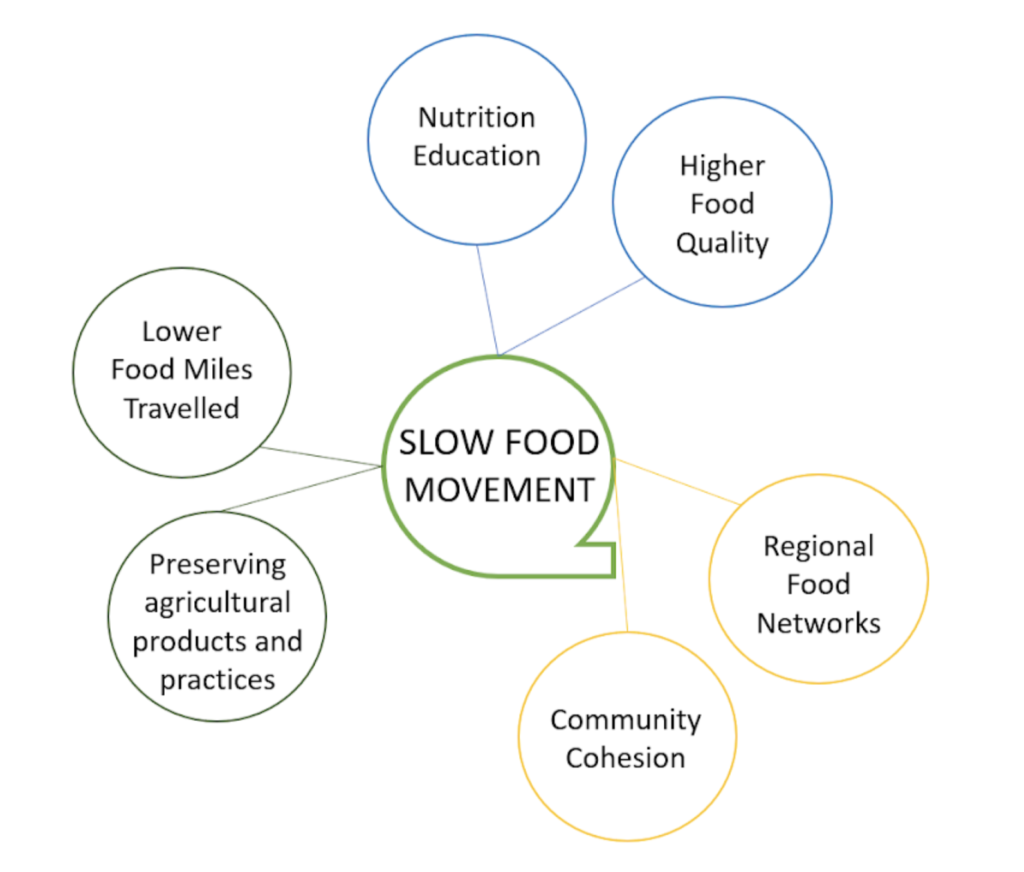
Identity is deeply connected to food, reflecting aspects like class, ethnicity, and culture. Slow Food promotes a social economy that preserves food as cultural heritage and emphasizes enjoyment and quality. In this process, a presidium offers resources for marketing, technical aid, Training (along specific guidelines set by Slow Food), Promotion, Communication and Networks, as well as assistance in navigating governmental regulatory systems. Members follow the principles of agroecology, place great value on the soil, water, animal welfare, and biodiversity, encompassing both the unseen biodiversity of microflora and the cultural diversity of traditional practices. Their methods aim to minimize the environmental footprint of food production (see figure 1: Lower Food Mile Travelled), avoiding the use of pesticides, antibiotics, preservatives, artificial additives, and dyes, and using detailed labels that describe every step of the production process.
This is practically for example achieved by incorporating endangered foods into restaurant menus, fostering regional food networks, and supporting small-scale producers to maintain traditional techniques. Together, community cohesion and loyalty help stabilize demand, even amid price fluctuations.
On a critical note, adopting cultural capital is normally associated with upper-income or highly educated circles. That connects the Slow Food movement with implied elitism, as well as prioritizing symbolic significance over practical utility. From a more feminist perspective, the by Slow Food’s self-proclaimed “right to enjoyment” abstracts from the gender-specific division of household labor. Particularly to be worked out is the close connection between land, tradition, and culture, which has a geodeterministic flavour to it, that can be further interpreted in a nationalistic way, in serious cases. The danger of social division and hierarchisation of the quality of individual regions and traditions arises from this. Lastly, at an overall societal level, this fundamental consumer sovereignty harbours great risks: Companies and governments will not, or only insufficiently, take responsibility for ensuring or promoting socially just and ecologically sustainable production and distribution conditions. This leads back to the structural problems in food ecosystems imposed by the capitalistically motivated international corporate food regime.
Comprehensively, as the root and beginning of life itself, seeds can be seen as a promising link between La Via Campesina and Slow Food as well as food movements in general, even on an urban-rural axis. Seeds serve as identification points and protectors of cultural heritage, their local variability increases ecological resilience against climate change related events (droughts, pests), and in contrast to genetically modified seeds, they grow healthier produce. The leading question is, what kind of life do we want to foster? Ending on an optimistic thought this also means: A “different world” is not only possible, but also, metaphorically speaking, “plantable”.
About the Author Valentina Bendl
Valentina Bendl studies Geography B.Sc. at the University of Augsburg. She is fascinated by the effects of the natural environment on humans and vice versa. In the context of food environments, the potential of seeds has particularly caught her eye, as this could be a key to a better human-environment relationship. She aims to communicate important scientific research to a wider audience in the future.
references of the guest post
- Brinkman, H., de Pee, S., Sanogo, I., Subran, L., & Bloem, M. W. (2010): High food prices and the global financial crisis have reduced access to nutritious food and worsened nutritional status and health. In: Journal of Nutrition, 140, 153–161.
- Herforth A., Ahmed S. (2015): The food environment, its effects on dietary consumption, and potential for measurement within agriculture-nutrition interventions, Springer, 505–520, DOI 10.1007/s12571-015-0455-8.
- Faldvad B. (2017): Die Food Movements und ihreForderungen: zur politischen Dimension alternativer Ernährungsgeographien The food movements and their claims: on the political dimension of alternative food geographies, In: Zeitschrift für Wirtschaftsgeographie, Vol. 62, No. 3-4, pp. 201-216, DOI:10.1515/zfw-2017-0010
- Fischler, C. (1988): Food, Self and Identity, In: Social Science Information Vol. 27 No. 2, pp. 275-292, Cambridge, MA, Harvard University Press, DOI: 10.1177/053901888027002005.
- Friedmann, H. (1993): The political economy of food: a global crisis. In: New Left Review, I/197, 29–57.
- Kareiva, P., et al. (2007): Domesticated nature: shaping landscapes and ecosystems for human welfare. Science, 316, 1866–9.
- Khoury, C., Bjorkman, A. D., Dempewolfe, H., Ramirez-Villegas, J., Guarinof, L., Jarvisa, A., et al. (2014): Increasing homogeneity in global food supplies and the implications for food security. Proceedings of the National Academy of Sciences, 111(11), 4001–4006.
- La Via Campesina (2020): United Nations Declaration on the Rights of Peasants and Other People Working in Rural Areas, Book of Illustrations.
- La Via Campesina, GRAIN (2015): Seed laws that criminalise farmers: resistance and fightback, https://grain.org/article/entries/5142-seed-laws-that-criminalise-farmers-resistance-and-fightback (23.03.24.).
- Messa M. et al. (2023): Slow Food, Annual Report 2022, pp. 6-46.
- Messa M., Sottile F. (2023): Slow Food’s Position Paper on Seeds., Slow Food.
- Milano S. et al. (2018): Biodiversity What is it, what does it have to do with our daily food, and what can we do to preserve it?, Slow Food. Monographs, Vol. 69, No.3, pp. 603–625, DOI: 10.1177/00380261211009061.
- Motta R. (2021): Social movements as agents of change: Fighting intersectional food inequalities, building food as webs of life, In: The Sociological Review
- Nyéléni Newsletter (2019): Peasant seeds, the heart of the struggle for food sovereignty, No. 38, La Vía Campesina and GRAIN.
- Oakes B. (2022): La Via Campesina and the Global Struggle for Food Sovereignty, Chapter 2 on Food Security and Food Sovereighty, The Violence of Development A companion website to the Pluto Press book by Martin Mowforth https://theviolenceofdevelopment.com/la-via-campesina-and-the-global-struggle-for-food-sovereignty/ (20.03.24).
- Pietrykowski B. (2004): You Are What You Eat: The Social Economy of the Slow Food Movement, Review of Social Economy Vol. 62, No. 3, pp. 307-321, DOI:10.1080/0034676042000253927.
- Winders, B. (2009): The vanishing free market: The formation and spread of the British and US food regimes. Journal of Agrarian Change 9(3): 315–344.
- Wittman, Hannah (2009): Reworking the metabolic rift: La Vía Campesina, agrarian citizenship, and food sovereignty In: Journal of Peasant Studies, 36: 4, 805-826, DOI: 10.1080